
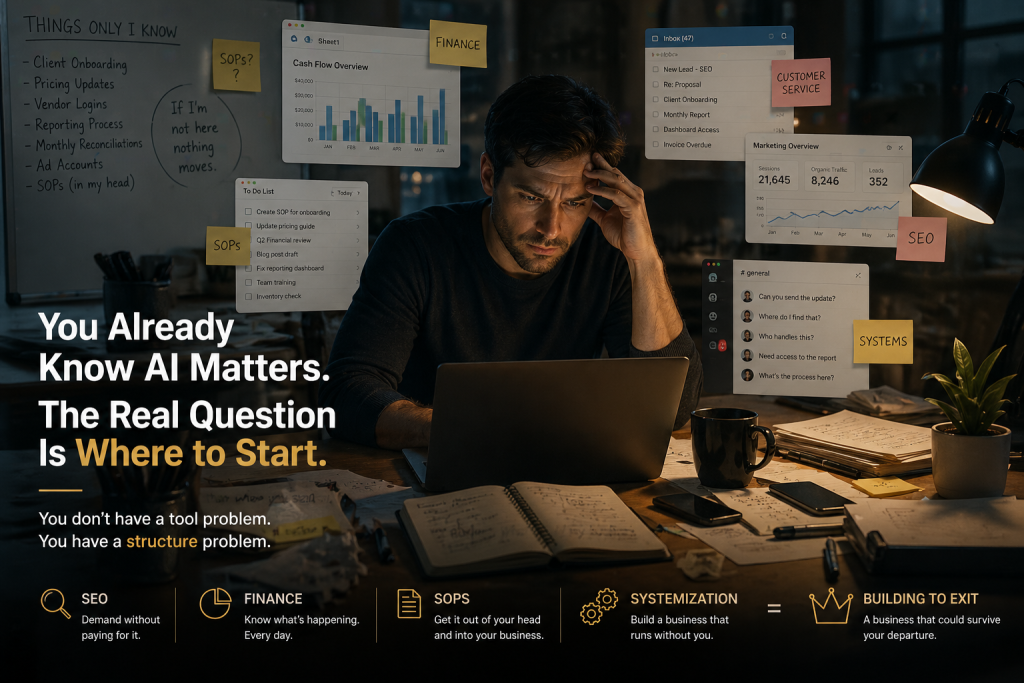
You don’t have a tool problem. You have a structure problem.
You’re past the “is AI going to matter for my business” conversation. You’ve watched enough podcasts, read enough LinkedIn posts, and heard enough peers say it to know the answer. AI is going to land in your industry. It might already have.
What you don’t have is a path. The list of where it could help you is now overwhelming. SEO. Financial modeling. SOP writing. Systemization. Customer-service automation. Sales enablement. Onboarding. Reporting. Forecasting. Inventory. Each one is a rabbit hole. Each one has a vendor pitching it.
None of them tell you which one to do first, or whether you should be doing any of them at this stage of your business.
You’ve probably already wasted a Saturday afternoon evaluating tools and ended up no closer to a decision than when you started.
Here is the question that makes the answer obvious. What would my business look like to someone who is buying it?
Not because you’re selling tomorrow. Because the question forces you to look at your business through a different lens. Buyers don’t care about your AI stack. They care about what runs without you. They care about what’s documented. They care about what the numbers say and who can read them. They care about whether the business survives the day after the founder hands over the keys.
The top four things mentioned, SEO and finance and SOPs and systemization, are not four separate AI projects. They are four faces of the same project. Building the business so it could survive your departure. That project goes by a name. We call it building to exit.
You don’t have to actually exit. Most of the owners I work with don’t, at least not for years. But every system you build is either making the business more sellable or making it more dependent on you. If you start from the exit question, the AI options sort themselves.
SEO. Most small businesses do this wrong because they treat it as marketing. It’s actually inventory. The keywords you rank for are the demand you have without paying for it. AI changes the math here in two ways. The cost of producing competent content has dropped to almost nothing, which means your competitors are already doing more of it. And search itself is being eaten by AI overviews, which means rank-one is not worth what it was. The right move depends on how much of your revenue comes from inbound. If you can’t answer that off the top of your head, that’s the first thing to fix.
Finance. AI is not going to replace your CPA. What it can do is read your books for you in real time and tell you the things your CPA only catches at quarterly close. Cash conversion cycle drift. Customer concentration creep. Margin erosion by service line. The owners who get this right run a daily dashboard that takes ten minutes to look at. The owners who get it wrong buy a $500-a-month tool and never open it. The difference is not the tool. It is whether you actually want to know.
SOPs. This is the one most owners avoid because they’re afraid the documented version will reveal how much of the business lives in their head. That fear is correct. The business does live in your head. The point of writing SOPs is to get it out. AI can do most of the typing now. It cannot make the decisions about what the SOP should say. That part is yours. But the last excuse, I don’t have time to write all that, is gone.
Systemization. This is the umbrella over the other three. A systemized business has a finance layer that runs without the owner watching it, a marketing engine that produces demand without daily attention, and operations that follow documented procedures. The order matters. Most owners try to do all three at once and finish none. The right sequence depends on which of the three is the biggest single point of failure for your specific business. If the business stops when you stop showing up, the answer is operations first. If the business runs but has unpredictable revenue, marketing is the limiting factor. If the business runs and has predictable revenue but you couldn’t explain to a buyer why it does, finance is the gap.
I’m not going to sell you AI tools. I’m going to help you figure out which of the four projects is the one you should do first, and why, given what your business actually is and what would make it more valuable. I’ve helped small businesses analyze their needs, systemize, prepare to scale, scale, and eventually sell. Some sold. Some didn’t sell and operated more profitably for years. A few decided after the analysis that they were closer to ready than they thought. None of them regretted starting from the exit question.
If you came here expecting me to tell you which AI tool to buy first, I’m going to disappoint you. There is no answer until I see your numbers, your team, your customer concentration, and.how much of the operation depends on you specifically being there.
What I can offer is the conversation that gets you out of the loop you’re stuck in. Sixteen questions. An hour of my time. A clear answer about what your business is actually worth right now and what would move that number the most. We call it the Snapshot Valuation. No pressure. No commitment. No upsell at the end.
Build to exit. Exit with clarity. Whether or not you ever actually sell, the work is the same.
Jake Taylor Exit With Jake